
Leave Your Message




Analysis of Roller Bearing Types in Tool Cabinets: Applicable Scenarios of Ball Bearings and Roller Bearings
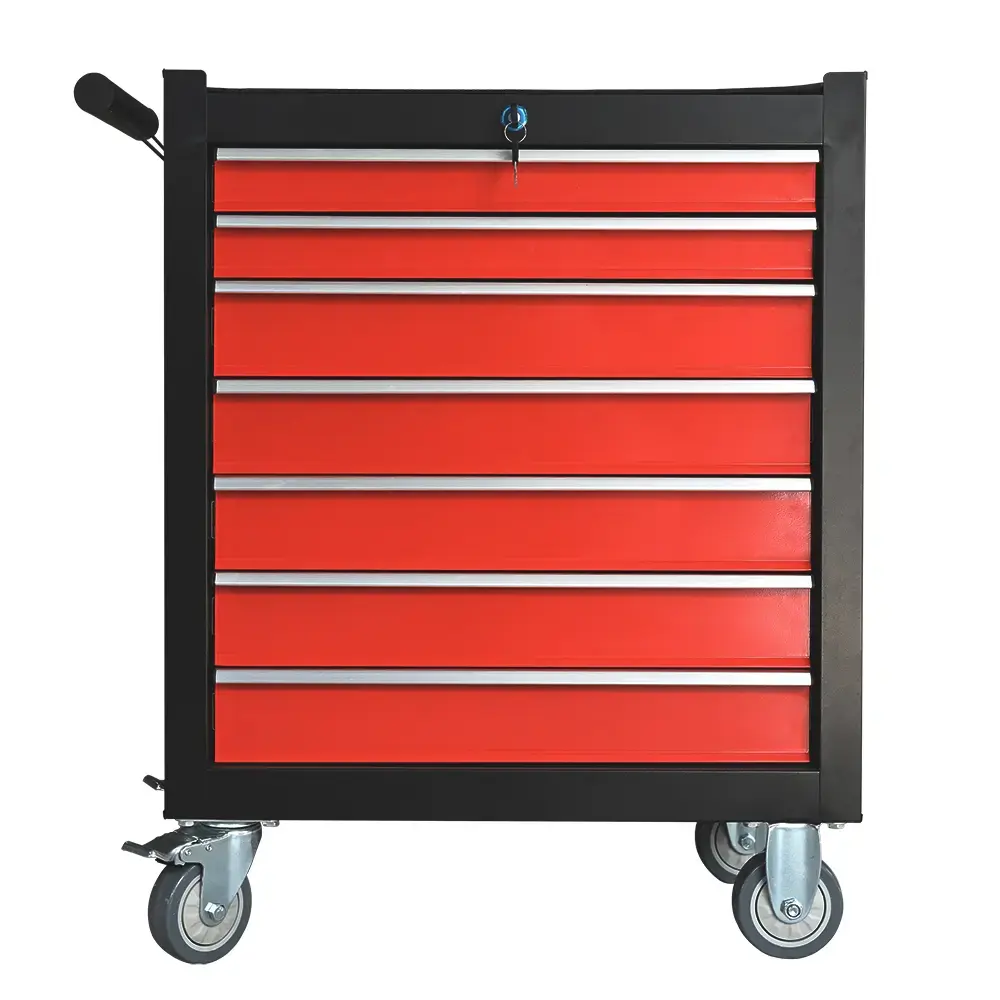
In modern industrial environments, the mobility of Tool Cabinets directly affects work efficiency and space utilization. As a key component of the tool cabinet, the selection of roller bearings is particularly important. Different types of bearing structures will bring about completely different load-bearing capacities, mobility characteristics and service lives. This article will delve into the technical features of ball bearings and roller bearings, helping you understand their respective applicable scenarios and providing professional references for choosing tool cabinets.
The technical characteristics and advantages of ball bearings
Ball bearings use spherical rolling elements that move on the raceway through point contact. This structure endows it with unique performance:
Structural features
Ball bearings consist of an outer ring, an inner ring, balls and a cage. The balls roll in the precisely machined raceways with an extremely low coefficient of friction, achieving smooth motion transmission. Due to its small contact area, the starting and running resistance is relatively low, and it can maintain good mobility even on uneven ground.
Performance advantage
The greatest advantage of this type of bearing lies in its flexibility and low-friction characteristics. The tool cabinet can be moved easily under no-load or light-load conditions. The operator only needs to apply a small thrust to achieve smooth movement. In addition, ball bearings have a strong adaptability to installation space and can be designed in various sizes and specifications to meet the requirements of tool cabinets of different sizes.
Applicable scenarios
Ball bearings are particularly suitable for medium-load tool cabinets that require frequent movement. In clean and flat environments such as electronic repair workshops and laboratories, tool cabinets equipped with ball bearings can provide an excellent mobile experience. Its rapid response feature is also suitable for application scenarios that require precise positioning, such as multiple position adjustments in narrow Spaces.

The structural design and performance of roller bearings
Roller bearings use cylindrical or conical rolling elements and transfer loads through line contact.
Structural features
The rolling elements of roller bearings are in linear contact with the raceways, and this design significantly increases the load-bearing area. Cylindrical rollers are suitable for radial loads, while conical rollers can withstand both radial and axial loads simultaneously. Precise roller processing ensures that each rolling element can evenly share the load.
Carrying capacity
Due to the larger contact area, the load distribution of roller bearings is more uniform. This feature makes it particularly suitable for heavy-duty applications, with a single bearing capable of withstanding several times the load of a ball bearing of the same size. Even under extreme load conditions, roller bearings can maintain stable performance.
Applicable environment
Roller bearings are an ideal choice for heavy-duty tool cabinets. In places such as auto repair workshops and industrial manufacturing plants where a large number of tools and equipment need to be stored, tool cabinets equipped with roller bearings can ensure safe and reliable movement. Its sturdy structural design can also better adapt to slightly uneven ground conditions.
Technical parameter comparison and analysis
Load capacity difference
The rated dynamic load of ball bearings is usually lower than that of roller bearings of the same specification. For instance, under the same size, the load-carrying capacity of roller bearings may be 30% to 50% higher. This difference is particularly important when choosing heavy-duty tool cabinets, and the safety factor and reliability for long-term use must be taken into consideration.
Comparison of friction characteristics
The starting friction of ball bearings is relatively small, but the coefficient of friction will increase significantly under high loads. On the contrary, roller bearings can maintain more stable friction characteristics under heavy load conditions, which makes them perform better in scenarios where a fully loaded tool cabinet needs to be moved.
Service life assessment
Under appropriate load conditions, both types of bearings can provide a long service life. However, when the load approaches the rated value, roller bearings usually exhibit a longer fatigue life. This is because the stress distribution in line contact is more uniform, reducing the possibility of local wear.
Application Scenario Selection Guide
Light to medium load applications
For tool cabinets with a load of less than 200 kilograms, ball bearings are usually a more economical and practical choice. In offices, school laboratories or light maintenance sites, this type of bearing can provide sufficient load-bearing capacity while maintaining excellent mobility flexibility. Its relatively low manufacturing cost also makes the tool cabinet more price-competitive.
Heavy industrial applications
In environments such as factory workshops and construction sites where a load of over 500 kilograms is required, roller bearings demonstrate obvious advantages. Its sturdy structure can withstand impact loads and vibrations, ensuring that the tool cabinet can still be safely moved under harsh conditions. Especially in situations where fully loaded tool cabinets need to be moved over long distances, the stability of roller bearings is even more crucial.
Special environmental considerations
In industrial environments with debris or dust, the sealing design of roller bearings is usually more reliable. The larger clearance and stronger structure make it more adaptable to harsh working conditions. In places where silent movement is required, such as hospitals or laboratories, ball bearings may be more suitable because their operating noise is usually lower.
Maintenance and durability considerations
Lubrication requirements
Both types of bearings require proper lubrication to ensure performance and service life. Ball bearings usually require more frequent lubrication and maintenance, but in smaller quantities. The lubrication cycle of roller bearings is relatively long, but more lubricant is required each time. When making a choice, the convenience and cost of maintenance need to be taken into consideration.
Installation requirements
Roller bearings have high requirements for installation accuracy and it is necessary to ensure precise alignment. However, ball bearings have a relatively high tolerance for installation errors. This factor is worth noting when considering the manufacturing process and maintenance convenience of the tool cabinet.
Environmental adaptability
The sealing performance of bearings is of vital importance in damp or chemical-containing environments. Roller bearings are usually equipped with more effective sealing devices, providing better anti-corrosion protection. In environments with significant temperature variations, the differences in the thermal expansion coefficients of the two types of bearings need to be taken into account.
Select suggestions and precautions
When choosing roller bearings for tool cabinets, the actual usage requirements should be comprehensively considered. First, assess the maximum load weight, including both static and dynamic load conditions. Secondly, consider the movement frequency and distance. High-frequency use may require more attention to the durability of the bearings. Finally, the ground conditions and usage environment should also be taken into consideration. Uneven ground requires bearings to have better impact resistance.
It is recommended that when making a selection, the supplier be asked to provide detailed bearing specification parameters, including rated dynamic load, limiting speed and lubrication requirements. At the same time, relevant industry standards such as ABMA or ISO standards can be referred to to ensure the manufacturing quality of bearings. For special application scenarios, customized solutions can also be considered, such as bearings with special seals or made of special materials.
By having a comprehensive understanding of the characteristics of ball bearings and roller bearings, you can select the most suitable tool cabinet for different application scenarios. The right choice can not only enhance work efficiency but also extend the service life of products, ultimately achieving better usage value.