
Leave Your Message




0102030405
Choosing Cold Rolled Steel: 0.8mm vs 1.0mm vs 1.2mm Tool Cabinets
2026-07-16
Selecting the correct cold rolled steel thickness is one of the most critical decisions when procuring Tool Chests, tool carts, and industrial storage cabinets. For B2B buyers, the difference between 0.8mm, 1.0mm, and 1.2mm steel directly impacts product lifespan, load capacity, and total cost of ownership. This guide provides a technical comparison to help you match the right gauge steel specification to your specific operational demands.
Understanding Steel Thickness: MM vs. Gauge Standards
In the global Tool Storage industry, steel thickness is expressed either in millimeters (mm) orGauge numbers.
Key Rule: The lower the gauge number, the thicker the steel sheet. For cold rolled steel (CRS), the conversion typically follows this standard:
- 18 gauge ≈ 1.2mm
- 19 gauge ≈ 1.0mm
- 20/21 gauge ≈ 0.8mm
While suppliers often refer to 18 gauge tool cabinets as heavy-duty, it is crucial to note that gauge conversions vary slightly between materials (e.g., stainless steel vs. galvanized steel). Always specify and verify the actual thickness in millimeters during contract negotiations and pre-shipment inspections to avoid discrepancies.

Technical Comparison: 0.8mm, 1.0mm, and 1.2mm CRS
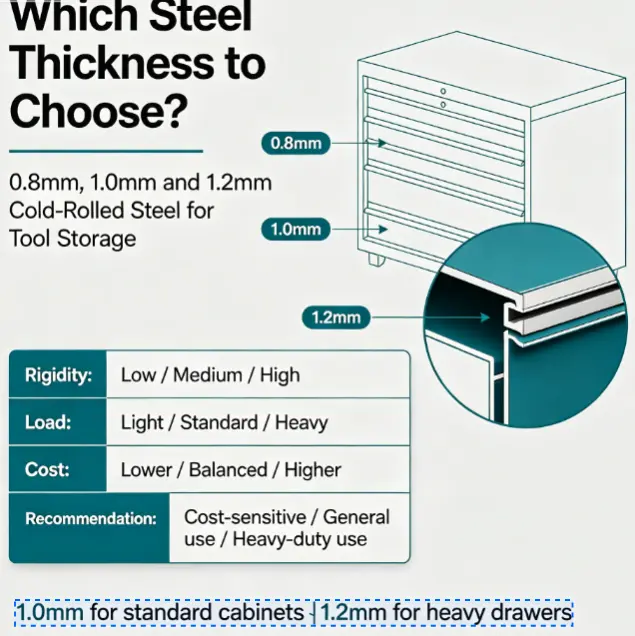
The following table outlines the performance differences between these three common specifications, helping you identify the best fit for your procurement needs.
| Feature | 0.8mm (Approx. 20-21 Gauge) | 1.0mm (Approx. 19 Gauge) | 1.2mm (18 Gauge) |
|---|---|---|---|
| Primary Use | Light-duty storage, side panels, non-load-bearing partitions | Standard drawers, residential tool cabinets | Heavy-duty tool chests, load-bearing frames, industrial workbenches |
| Load Capacity | Low; suitable for light hand tools | Moderate; adequate for general maintenance kits | High; significantly stronger, ideal for power tools and heavy parts |
| Durability & Impact | Prone to denting under impact or heavy loads | Resists daily wear; better rigidity than 0.8mm | Excellent impact resistance; maintains structural integrity during drops |
| Weldability | Higher risk of heat distortion during welding | Good welding adaptability | Superior weld strength; ideal for structural reinforcements |
| Ideal Application | Home workshops, budget-sensitive projects | School labs, office storage, light-industrial use | Automotive repair shops, heavy manufacturing, high-frequency industrial environments |
| Relative Cost | Lowest | Moderate | Higher (reflects increased material and reinforcement costs) |
Procurement Decision Framework: Matching Specs to Scenarios
Choosing between 0.8mm, 1.0mm, and 1.2mm cold rolled steel involves balancing environment, load requirements, and lifecycle costs.
1. Assess the Operational Environment
- High-Impact Risk: If equipment is exposed to forklift traffic or falling engine parts (common in automotive workshops), prioritize 1.2mm steel. The structural redundancy prevents catastrophic failure.
- Standard Wear: For controlled environments like schools or assembly lines with fixed protocols, 1.0mm steel offers the best balance between durability and investment.
2. Calculate Static and Dynamic Loads
Identify your heaviest single tool and the total weight per drawer. For high-density storage, 1.2mm steel is recommended for drawer bottoms and cabinet frames to prevent sagging deformation over time.
3. Evaluate Total Cost of Ownership (TCO)
- 0.8mm Steel: Lower upfront cost but higher long-term expense due to frequent replacements in demanding settings.
- 1.2mm Steel: Higher initial capital expenditure, but the superior durability results in a lower cost-per-year, making it the logical choice for mission-critical assets.
B2B Sourcing Checklist for Tool Storage Equipment
When communicating with manufacturers, ensure your RFQ (Request for Quotation) includes these technical requirements to guarantee quality:
- Specify Base Material: Insist on SPCC or Q235 grade cold rolled steel. Define acceptable thickness tolerances in the purchase agreement.
- Structural Reinforcements: Inquire about reinforcing ribs or flanges. A well-engineered 1.0mm steel cabinet with proper bracing can sometimes match the rigidity of a flat 1.2mm panel.
- Demand Load Test Reports: Request evidence of dynamic load testing (e.g., 50kg drawer capacity tested over 10,000 cycles). Do not rely solely on theoretical data sheets.
Conclusion
Effective tool storage procurement is about precision matching rather than simply buying the thickest steel available. By understanding the distinct performance profiles of 0.8mm, 1.0mm, and 1.2mm cold rolled steel, you can secure a solution that optimizes both your budget and your workshop's operational reliability.