
Leave Your Message




0102030405
Cost Drivers Behind 5-Drawer vs 7-Drawer Rolling Tool Cabinets
2026-07-14
Raw Material Consumption & Structural Component Incremental Costs
Raw materials typically account for 40% to 60% of the total manufacturing costof a Rolling Tool Cabinet. Among these,steel sheet specifications and usage volume are the fundamental variables determining the price difference between 5-drawer and 7-drawer models. A 7-drawer cabinet requires additional cold-rolled steel or galvanized steel for drawer boxes, front panels, and internal reinforcement ribs due to two extra drawer units. Meanwhile, the overall cabinet height and side panel area usually increase accordingly.
Under the same steel thickness (e.g., 0.8mm to 1.0mm cold-rolled steel), each additional pair of drawers not only increases metal material weight but also raises scrap loss rates during cutting and bending. If a 7-drawer cabinet upgrades slide mounting positions or thickens the bottom panel to support higher load capacity, material costs will widen further. In procurement evaluation, buyers should focus on hidden cost drivers such as steel gauge impact on rolling tool cabinet cost and raw material weight difference 5 drawer vs 7 drawer Tool Chest.
Precision Component Configuration & Hardware Fitting Overhead Costs
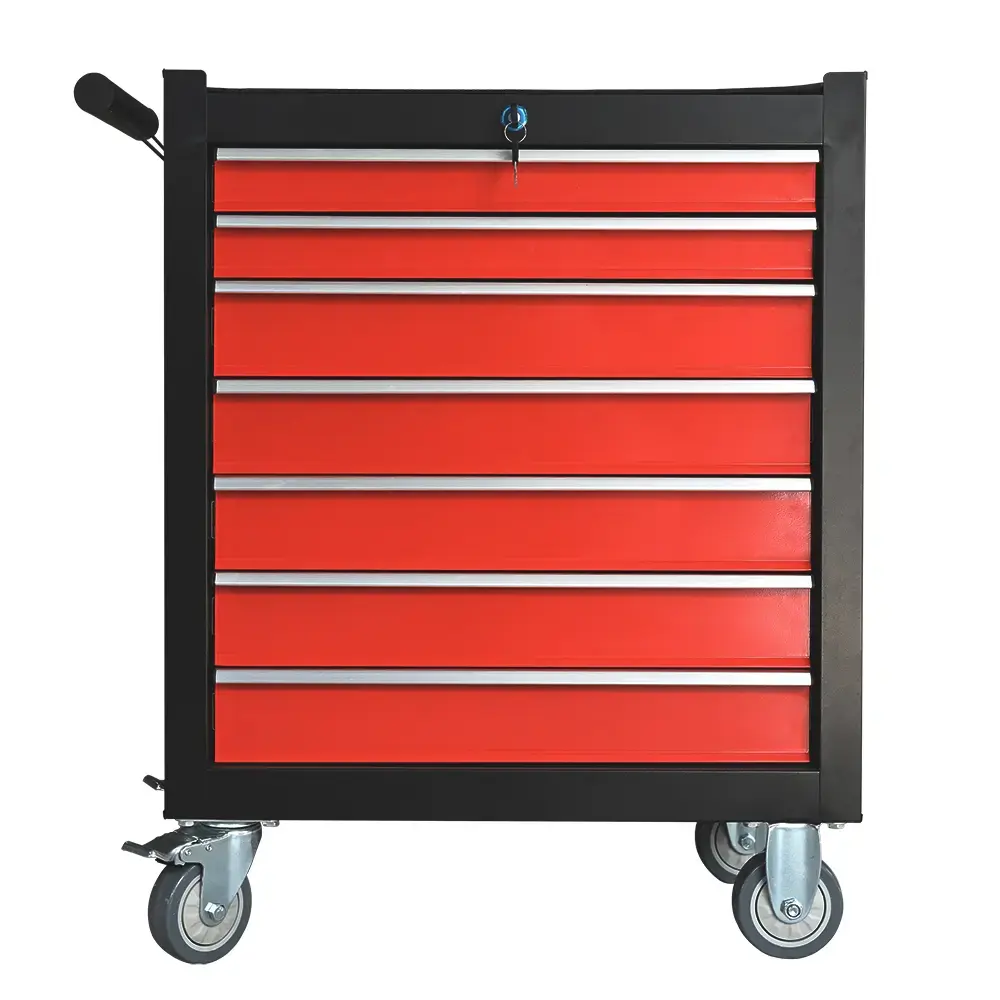
Drawer quantity directly and linearly increases the procurement volume and cost of hardware fittings. Core high-value components of rolling tool cabinets include ball bearing slides, drawer handles, lock systems, and central locking mechanisms. Compared with a 5-drawer cabinet, a 7-drawer unit requires two additional sets of heavy-duty ball bearing slides (one left and one right). Industrial-grade full-extension ball bearing slides cost significantly more per set than standard slides, making this a common area for cost-cutting in price-sensitive quotations.
In addition, caster systems (usually 4-inch to 5-inch heavy-duty oil-resistant casters), non-slip drawer liners, aluminum handles, and safety latches must be increased or reinforced proportionally with drawer count. In international search contexts, such costs are often categorized as ball bearing slide cost in 7 drawer tool cabinet, hardware fittings markup rolling tool trolley bulk order, and central locking system pricing for multi drawer tool chest.

Processing Complexity & Surface Treatment Area Variables
Labor and equipment depreciation costs on the manufacturing side increase with process complexity. A 7-drawer cabinet involves more passes of laser cutting, CNC bending, and welding operations — especially full or spot welding of drawer boxes, which demands higher labor hours. Multi-drawer structures impose stricter tolerance controls for cabinet verticality and drawer parallelism, indirectly raising quality inspection and rework costs.
Surface treatment processes (such as electrostatic powder coating) are generally priced by workpiece surface area and pretreatment complexity. With more internal cavity structures and greater masking difficulty, 7-drawer cabinets consume slightly more powder coverage and curing energy than 5-drawer models, and require more samples for salt spray and adhesion testing. Relevant discussions align with keyword logic including powder coating cost calculation for metal tool cabinet and welding labor cost difference 5 drawer vs 7 drawer rolling chest.
Tooling Amortization, Packaging Volume & Container Loading Efficiency Differences
In bulk orders, non-standard sizes or customized panels may involve tooling costs (e.g., stamping dies, LOGO inserts). Large order volumes can dilute one-time mold investments; however, if a 7-drawer cabinet requires dedicated new drawer molds, the initial quotation will reflect this amortization expectation.
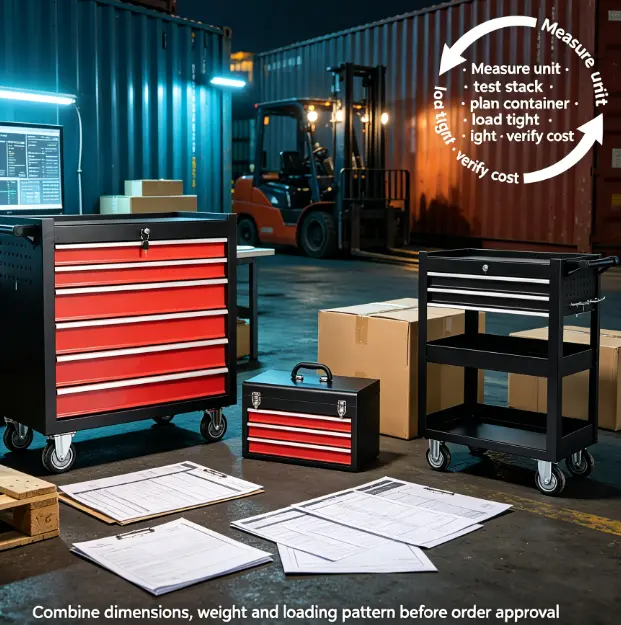
A more critical hidden cost lies in logistics. Due to increased height and weight, the per-unit packaging volume (CBM) of a 7-drawer cabinet expands, resulting in lower container loading quantities (for 20FT and 40HQ containers) compared to 5-drawer units. For similar specifications, loading efficiency for 5-drawer cabinets can be approximately 15% to 20% higher, driving up per-unit ocean freight and packaging material costs (cartons, EPE foam, wooden pallets). This is a core calculation metric in procurement research such as container loading efficiency 5 drawer vs 7 drawer tool cabinet and ocean freight cost per unit rolling tool chest bulk import.
Certification Compliance, Volume Tiers & Bulk Negotiation Margins
Major global import markets require metal storage equipment to meet ISO 9001, CE marking, RoHS, and regional mechanical product compliance assessments. Heavy-duty 7-drawer cabinets, with higher rated load capacities (e.g., 300kg to 400kg total load), incur slightly higher prototype testing consumption and certification documentation costs.
MOQ (Minimum Order Quantity) and price tier breakpoints are key negotiation dimensions for buyers. Typically, order volumes exceeding specific thresholds (e.g., 50 units, 100 units) trigger centralized steel purchasing discounts and labor efficiencies from continuous production runs. 5-drawer cabinets, with relatively universal structures and high standardization, more easily reach cost floors in large volumes. For moderately customized 7-drawer cabinets (e.g., internal drawer dividers, non-standard heights), bulk discount slopes tend to be gentler. This dimension correlates with bulk order discount structure for metal tool cabinets, MOQ pricing tiers rolling tool trolley supplier, and cost benefit analysis standard vs custom 7 drawer tool chest.
Conclusion
Overall, the price difference between 5-drawer and 7-drawer rolling tool cabinets reflects not only the physical cost of two extra drawers but also the combined effects of material utilization, component grades, logistics volume, and compliance depth. Professional buyers should require suppliers to provide an itemized quotation, clearly specifying steel thickness, slide brand, surface treatment process, and trade terms (EXW/FOB/CIF) item by item, rather than only comparing final total prices.
