
Leave Your Message




0102030405
Security Solution Provider Procurement Guide: Safety & Security Tool Management Advantages of 4-Drawer Interlock Carts
2026-04-20
For professional security system integrators, airport security equipment suppliers, or large-scale factory security solution designers, the rigor of tool management directly determines whether the end client’s safety audit can be passed. In high-security locations requiring strict tool flow control—such as prisons, data centers, nuclear power plants, or aircraft manufacturing lines—a single unregistered wrench or missing screwdriver can pose a serious security hazard. A 2022 airport security checkpoint tool management audit report released by theTransportation Security Administration (TSA)stated that among 30 randomly inspected airport maintenance sites, 17% of tool loss incidents resulted from unregulated open Tool Storage.
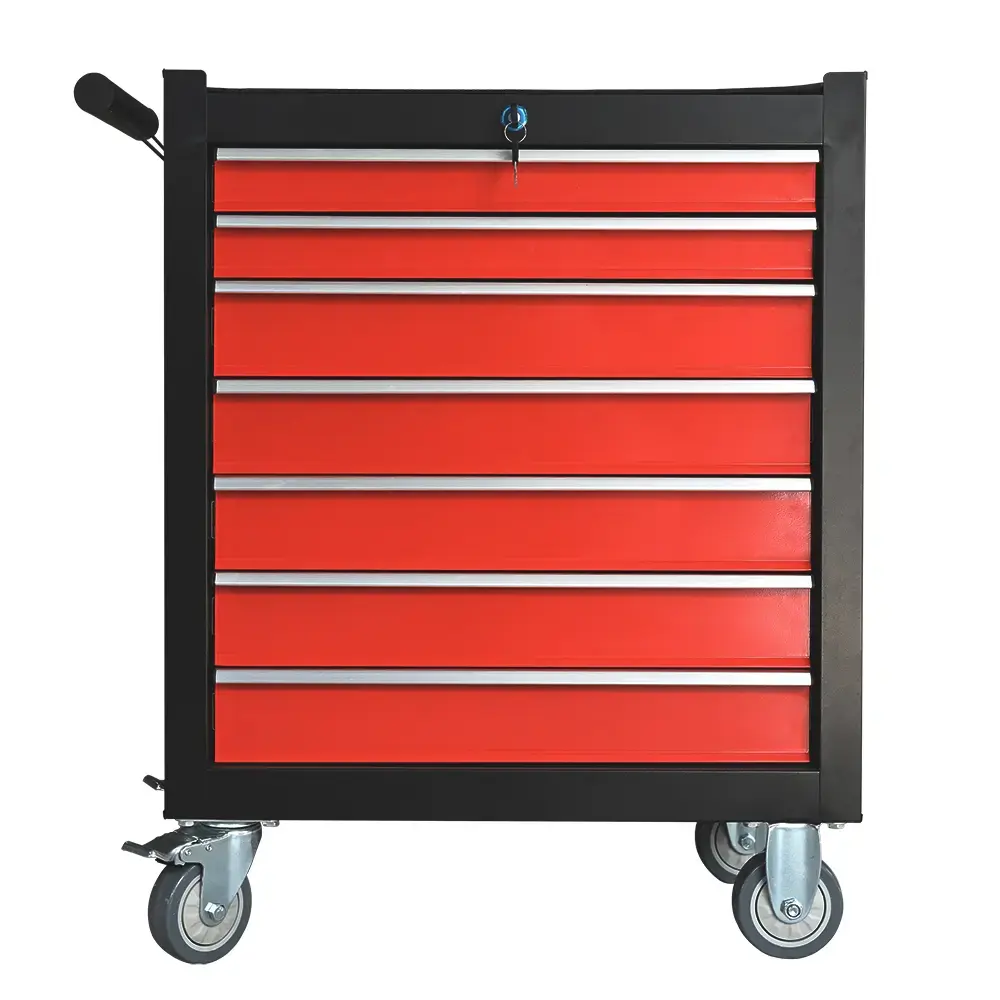
Among numerous tool management solutions, security carts equipped with a 4-drawer interlock mechanism are becoming the new benchmark for professional procurement. This design is not a simple functional overlay, but a systematic security solution based on physical error-proof principles. For security solution providers selecting tool storage equipment for high-end clients, understanding the safety mechanism and management advantages of 4-drawer interlock carts is a prerequisite for making correct procurement decisions.
Understanding the Core Safety Principle of the Drawer Interlock Mechanism
The most common safety loophole in ordinary tool carts is: when multiple drawers are opened simultaneously, the cart’s center of gravity shifts forward, causing tipping, or tools scatter because drawers are forgotten to be locked during movement. However, the risks in security scenarios are far more than that.
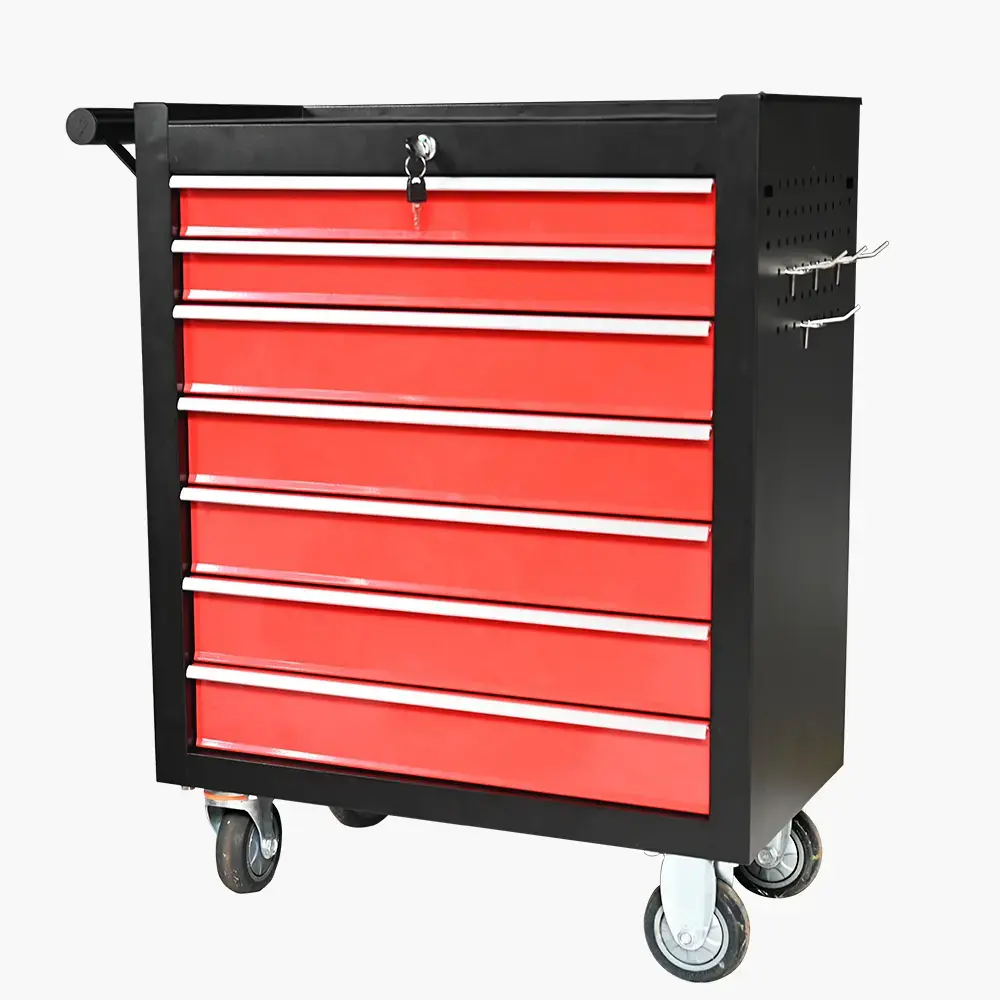
A 4-drawer interlock is a purely mechanical linkage device, with its core logic: at any time, only one drawer can be opened at most. When one drawer is pulled out, the mechanism automatically locks the other three drawers through a connecting rod or cam structure, preventing them from being opened. Only when the opened drawer is fully pushed back to the closed position will the locked state of the other drawers be released.
This mechanism has two key values in security management:
- Prevent Accidental Opening During Transportation: When the cart moves through security checkpoints or crowded areas, even if the main lock is forgotten to be pressed, only one drawer can be in the open state due to the interlock mechanism, which greatly reduces the risk of tools accidentally falling and being picked up by others.
- Force the Establishment of a Tool Inventory Sequence: When security personnel hand over shifts, they need to open drawers one by one to check tools. The interlock mechanism forces them to face only one drawer at a time, avoiding tool mixing or missed inspections caused by opening two drawers simultaneously.
Security Management Advantages of the 4-Drawer Configuration
Compared with similar products with 2 or 3 drawers, the 4-drawer interlock cart specially designed for security scenarios provides a finer granularity in tool classification management.
1. Achieve Hierarchical Permission Isolation of Tools
Security solution providers can set different security levels for different drawers:
- Drawer 1 (Top Layer): Stores high-value precision tools that need to be inventoried daily, such as torque wrenches, electronic testers, and laser rangefinders.
- Drawer 2: Stores commonly used Hand Tools, such as screwdriver sets, hex keys, and pliers.
- Drawer 3: Stores consumable security equipment, such as seals, batteries, and temporary locks.
- Drawer 4 (Bottom Layer): Stores large or heavy tools, such as impact drills, cable cutters, and hammers.
This layered storage simplifies the three daily tool inventories from "opening all drawers and checking each item one by one" to "only opening the top drawer to check high-value tools and visually confirming that the other drawers are locked," improving efficiency by approximately 60%.
2. Meet the Visualization Requirements of Audit Tracking
In security audits, inspectors need to confirm that all tools have been returned to their positions at the end of the workday. The 4-drawer interlock cart, combined with transparent polycarbonate drawer panels or internal sponge-carved tool outlines, enables "quick pre-inspection without opening drawers." The interlock mechanism ensures that when the cart is pushed into the storage area and locked, no drawer will slide out accidentally, thereby avoiding the risk of tool loss in the locked state.
Quantifiable Safety Indicators to Evaluate During Procurement
When security solution providers inquire about prices from suppliers, they should not only focus on "whether there is an interlock" but also require the other party to provide specific specifications in the following four dimensions:
| Safety Indicator | Recommended Value for Security Scenarios | Verification Method |
|---|---|---|
| Interlock Mechanism Durability | No less than 10,000 trouble-free openings and closings | Request third-party laboratory test report |
| Single Drawer Static Load Capacity | No less than 30 kg, and the interlock mechanism does not fail | Test pulling after actual weight placement |
| Cart Tipping Critical Angle | When the highest drawer is pulled out, the cart tilts forward no less than 15 degrees without tipping | Slope test in accordance with ANSI standards |
| Main Lock Anti-Damage Level | At least two-point locking (central lock rod + top lock bolt) | Check if the lock tongue penetrates the side wall of the drawer |
Practical Testing Methods in Procurement Decision-Making
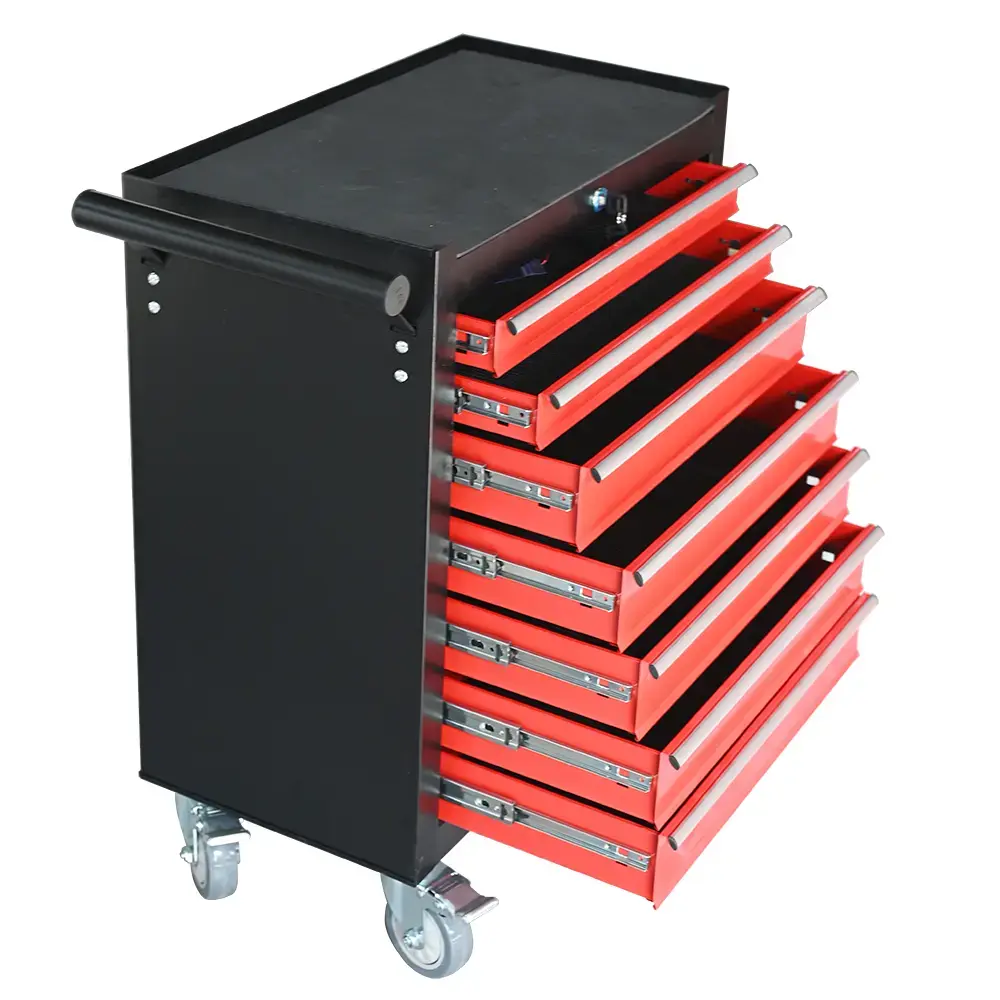
Before finalizing the procurement, it is recommended that solution providers request samples from suppliers and conduct the following three simulation tests:
Test 1: Interlock Function Consistency Check
Steps: Close all four drawers. Pull each drawer to the half-open and fully open positions one by one, and try to pull the other three drawers while keeping the drawer open.
Qualified Standard: The other drawers should not be able to be pulled open more than 10 millimeters. If a non-open drawer can be partially pulled open, it indicates that the stroke adjustment of the interlock mechanism is inaccurate.
Test 2: Locking Safety in Moving State
Steps: Close all drawers but do not activate the central main lock. Push the cart through a rough surface (such as floor tile joints or carpet edges) at a normal walking speed (about 1 meter per second) and simulate emergency braking.
Qualified Standard: All drawers should not slide out on their own due to vibration. For security purposes, damping slides are a better choice than ordinary ball slides because they provide the final closing holding force.
Test 3: Reliability After Long-Term Use
Steps: Select one drawer for 50 consecutive full-stroke pulls, and check the locking effect of the interlock mechanism on other drawers every 10 times.
Qualified Standard: There should be no delay or jamming in the interlock response. If the interlock mechanism begins to have occasional failures after 50 operations, it indicates that this model is not suitable for high-frequency security environments.
Summary of Procurement Checklist for Security Solution Providers
When configuring tool management solutions for clients such as airports, data centers, laboratories, or military facilities, 4-drawer interlock carts should be a standard configuration rather than an optional upgrade. The following are the five key points to check during procurement:
- Interlock Type: Confirm it is a purely mechanical interlock (recommended) rather than a design relying on spring reset (lower reliability).
- Slide Quality: Request a fatigue test report of the slides to ensure they remain smooth and do not cause interlock misalignment under frequent opening and closing.
- Wheel Set Configuration: For security purposes, it is required to be equipped with two swivel wheels with brakes, and the brakes should be able to lock the wheel rim and steering simultaneously to prevent the cart from moving accidentally on slopes.
- Anti-Static Option: For tool carts used in data centers or electronic maintenance workshops, ask if anti-static desktops and grounding chain configurations are provided.
- Traceable Identification: Each cart should have a unique serial number metal nameplate to facilitate asset management and tracking after loss.

By systematically evaluating the above safety and management advantages, security solution providers can provide clients with not only a tool transportation device but also an error-proof tool control node integrated into daily work processes. This will be directly reflected in the end client’s safety audit scores and operational efficiency improvement.
Ten Relevant Keywords