
Leave Your Message




0102030405
Top Tips for Choosing Reliable Tool Storage Suppliers
2026-05-12
As a wholesaler in the building materials or hardware industry, your core competitiveness lies not only in sales channels but also in whether the supply chain behind you is reliable, efficient, and has long-term cooperation value. Choosing suppliers for tool storage products (toolboxes, tool carts, tool cabinets) is by no means a simple "price comparison" game, but a comprehensive evaluation of production capacity resilience, quality control systems, and after-sales response capabilities. This article will break down the core dimensions of selecting high-quality suppliers from a global wholesaler’s perspective.
I. Production Capacity and Delivery: The "Ballast Stone" of Stable Supply
For wholesalers, sales losses and customer churn caused by stockouts are fatal. To evaluate a supplier’s delivery capacity, you need to look beyond the superficial "having a factory" and focus on its production planning and scheduling capabilities—this is key to hardware and building materials wholesale supply chain management.
1. Verification of Production Capacity Authenticity
Equipment and Automation Level: High-quality suppliers should have CNC punch presses, laser cutting machines, automated welding robots, and electrostatic powder coating lines. This is not only related to efficiency but also determines product consistency and production capacity peaks. Inquiring about the tonnage and quantity of their key equipment (such as bending machines) is the basis for judging whether they can undertake large orders.
Raw Material Inventory Strategy: Stable suppliers usually have strategic inventories of raw materials such as cold-rolled steel plates and SPCC steel, and can provide Material Test Certificates (MTC). This can effectively avoid delivery delays caused by fluctuations in the raw material market, a critical part of hardware and building materials wholesale supply chain management.
2. Evaluation of Supply Chain Resilience
On-Time Delivery (OTD) Commitment: Require suppliers to provide standard delivery times based on historical data (e.g., 30-45 days), and ask about their plans to respond to surging orders during peak seasons (e.g., whether flexible production units are used).
Logistics Collaboration: Mature suppliers will establish a clear system of trade terms such as FOB or EXW, and have a stable network of cooperating freight forwarders. They can assist you in handling export customs clearance and ocean freight booking, ensuring a smooth link from the factory to your warehouse—an essential aspect of hardware and building materials wholesale supply chain management.
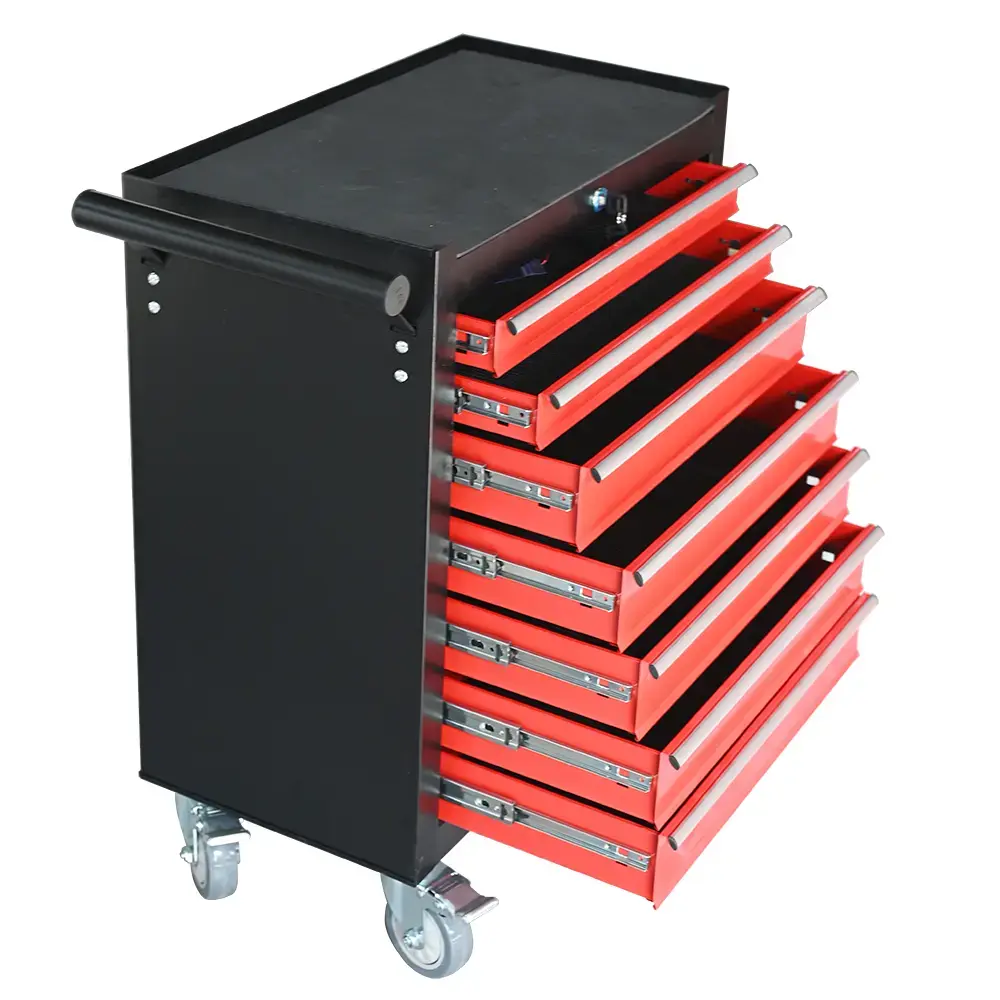
II. Quality Bottom Line: Quality Control Logic from "Usable" to "Durable"
Tool Storage products directly face high-intensity use by end users (auto repair shops, construction sites). Quality defects will lead to high-frequency returns and after-sales claims, which is a key pain point for B2B procurement.
1. Structural Design and Material Standards
| Components | Industrial-Grade Standards | Wholesaler Verification Points |
|---|---|---|
| Box/Cabinet Body | Using 1.0-1.2mm thick cold-rolled steel plates | Request material thickness reports; be wary of thin plates or recycled materials, which relates to industrial Toolbox SPCC steel thickness standards. |
| Drawer System | Full-extension ball bearing slides with marked load-bearing capacity | Test the smoothness and impact resistance of drawers when fully loaded (e.g., 100kg), a key part of Tool Cabinet drawer slide load-bearing testing. |
| Locks and Handles | Zinc alloy die-casting or reinforced steel structure | Check the anti-pulling and anti-prying design of the lock core, as well as the firmness of the handle welding/riveting. |
| Coating Process | Phosphating pretreatment + epoxy resin powder coating | Inquire about the hours of salt spray test for tool storage products (high-quality products usually ≥ 48h), which reflects the quality of tool cabinet powder coating process. |
2. Certification and Testing Systems
International Certifications: For products exported to European and American markets, suppliers should be able to provide basic certifications such asCE, FCC, RoHS for tool carts. For heavy-duty tool cabinets, ANSI/BIFMA testing for heavy-duty tool cabinets reports are a strong endorsement of quality.
Internal Quality Control: Inquire whether the supplier has an IPQC (In-Process Quality Control) team and FQC (Final Quality Control) processes. A standardized factory will retain random inspection records and performance test data for each batch of products (such as video of drawer dynamic load testing).
III. After-Sales and Collaboration: The Neglected "Hidden Costs"
A supplier’s after-sales capability is directly related to your brand reputation and operating costs. An excellent supplier should be your "strategic logistics support."
1. After-Sales Response Mechanism
Spare Parts Support: Inquire whether the supplier provides a list of vulnerable parts (such as slides, lock cores, casters) and their inventory status. Can replacement parts be sent within 7-10 working days after a quality problem occurs?
Claim Process: Clarify the responsibility definition standards for quality issues and the Claim S.O.P. (Standard Operating Procedure). Mature suppliers will provide an RMA (Return Material Authorization) process for toolbox suppliers, rather than shirking responsibility.
2. Customization and Collaboration Capabilities
Brand Customization: Does it support OEM/ODM? Including laser marking (Logo), private labeling packaging, and color customization (e.g., RAL color card). This determines whether you can establish a differentiated brand image, which is closely related to toolbox OEM foundry quality standards.
Technical Collaboration: When you develop new product categories (such as mobile tool carts of specific sizes), can the supplier’s engineers provide DFM (Design for Manufacturability) suggestions to help you optimize the structure and reduce costs?

IV. Supplier Classification Evaluation Model
Before making the final decision, it is recommended to score potential suppliers (1-5 points) according to the following model, which helps in tool cabinet wholesale supplier screening:
| Evaluation Dimensions | Weight | Evaluation Points |
|---|---|---|
| Production Capacity and Delivery | 30% | Equipment automation rate, raw material inventory, historical OTD compliance rate |
| Quality System | 30% | Material thickness, completeness of certifications, authenticity of test reports |
| Cost Competitiveness | 20% | Quote transparency (whether tax/shipping is included), mold cost sharing mechanism |
| After-Sales and Collaboration | 20% | Spare parts inventory, RMA response time, customization cooperation |
Procurement Recommendation: For wholesalers with stable annual purchase volumes, it is recommended to establish strategic cooperation with 1-2 suppliers with a comprehensive score of 4 points or above, rather than dispersing orders to multiple low-price factories. Concentrated purchase volume can exchange for better payment terms and higher after-sales priority, optimizing hardware and building materials wholesale supply chain management.
Conclusion
Choosing a tool storage product supplier is essentially finding the optimal balance between unit price, delivery risk, and long-term operation and maintenance costs. As a building materials wholesaler, what you need is not an intermediary who only quotes low prices, but a manufacturing partner with a complete quality control system, stable production capacity reserves, and fast after-sales support. Remember: stable supply determines your sales upper limit, and comprehensive after-sales service determines your risk lower limit—this is the core of tool cabinet wholesale supplier screening.