Leave Your Message




0102030405
Moisture-Resistant Lockable Outdoor Tool Boxes for Southeast Asia
2026-05-19
For professional building material wholesalers, when selecting storage solutions for end users—including construction sites, property maintenance teams, farms, and outdoor engineering contractors—the moisture resistance of lockable outdoor tool boxes is a core indicator that directly determines product service life and tool safety. Especially in the Southeast Asian market, the hot, humid, and rainy maritime climate imposes far stricter requirements on corrosion resistance and sealing performance of metal tool boxes than European and American standards.
Based on material science and real climate data, this guide breaks down key moisture-proof technical parameters from a sourcing perspective and analyzes how to precisely tailor products to the unique operating environments across Southeast Asian countries.
1. Why Moisture Resistance Must Be the Top Sourcing Priority in Southeast Asia
Southeast Asia—including Thailand, Vietnam, Malaysia, Indonesia, and the Philippines—has an average annual relative humidity of over 80%, with monthly rainfall exceeding 300mm during the monsoon season. In such conditions, standard outdoor tool boxes face three major failure risks:
Electrochemical Corrosion
When humidity exceeds 60%, micropores in the coating of carbon steel cabinets form an electrolyte film, causing rust to spread rapidly from scratches. According to NACE International (Association for Corrosion Engineers), standard Steel Tool Boxes without specialized anti-rust treatment have an outdoor service life of no more than18 months in tropical marine climates.
Seal Failure
Low-quality rubber gaskets accelerate thermal-oxidative aging at temperatures above 40°C, becoming hard and shrunken, allowing moist air to penetrate directly during rainy seasons. Tests show that compression set of some cheap gaskets exceeds 50% after just 6 months of use in Southeast Asia, resulting in complete loss of protective performance.
Condensation Damage
Large day-night temperature differences—for example, 45°C at noon and 25°C at night in Thailand—cause hot air inside the cabinet to condense into water droplets. These droplets drip onto circuit boards of power tools, leading to short circuits or contact oxidation.
Conclusion: In Southeast Asia, moisture resistance = tool safety = customer repurchase rate. Wholesalers should prioritize suppliers whose products are clearly labeled “suitable for tropical climates” or supported by official moisture resistance test data.
2. Five Key Technical Indicators for Moisture Resistance of Lockable Outdoor Tool Boxes
When sourcing, verify product specifications or require third-party test reports, focusing on these critical parameters:
1. Protection Rating: IP54 as Minimum Threshold, IP66 as Preferred
- IP54: Dust-protected (invasion does not affect operation) and splash-proof in all directions. Suitable for covered outdoor areas such as eaves and carports.
- IP65 / IP66: Totally dust-tight; resistant to low-pressure water jets (IP65) or powerful water jets (IP66). Ideal for open construction sites and coastal ports.
Sourcing Tip: For open-air sites in Southeast Asia, IP66 or higher is mandatory. Effective sealing relies on one-piece foamed gaskets (superior to glued rubber strips) and continuously welded cabinets (better than bolt-assembled structures).
2. Cabinet Material & Surface Treatment: Galvanized Steel + Powder Coating as Standard, Stainless Steel as Premium Solution
- Hot-dip galvanized steel: SPCC cold-rolled steel with double-sided zinc coating ≥ 80g/m². The zinc layer acts as a sacrificial anode, extending outdoor service life to 3–5 years.
- Polyester / epoxy powder coating: Coating thickness ≥ 80μm, must pass 500-hour salt spray test (ASTM B117). High-end products reach 720–1000 hours.
- 304 stainless steel: Contains 18% chromium and 8% nickel, forming a dense passivation film. Performs exceptionally in high-salt marine environments but costs 2–3 times more. Recommended only for extreme areas within 5km of coastlines.
3. Rustproof Locking Mechanism: The Most Overlooked Weak Point
Standard padlocks or zinc-alloy lock cylinders often jam or seize within 3–6 months in humid air. Professional lockable outdoor tool boxes should include:
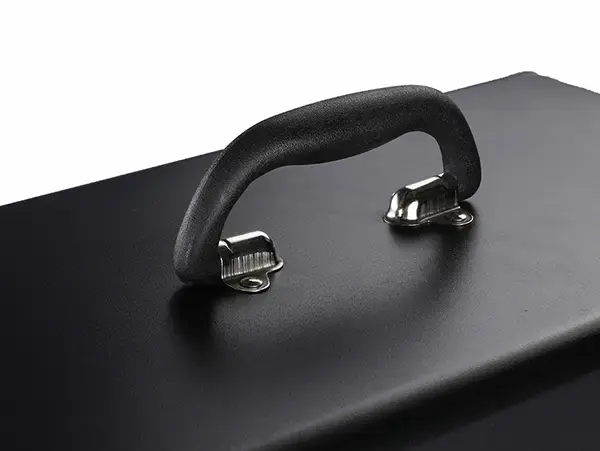
- Fully enclosed cylinder locks with internal grease and external waterproof dust caps.
- Lock bodies made of brass or stainless steel; ordinary chrome-plated steel parts are strictly prohibited.
Performance Requirement: After 48 hours in a 35°C / 90% RH chamber, the lock must operate smoothly for 100 cycles without jamming.
4. Anti-Condensation Design: Physical Structure & Auxiliary Solutions
- Labyrinth vents with insect screens on both sides for natural convection to reduce condensation.
- Drain holes (3–5mm diameter with rubber plugs) at the lowest point to remove accumulated moisture.
- Built-in slots for replaceable silica gel desiccant to lower initial internal humidity.
3. Differentiated Adaptation Recommendations for Southeast Asian Countries
Despite overall high humidity, microclimates vary significantly. Wholesalers can customize sourcing requirements by market:
| Country | Climate Features | Special Requirements | Recommended Configuration |
|---|---|---|---|
| Thailand, Vietnam | Extreme heat & humidity, concentrated monsoons, many inland sites | High UV resistance, resistance to heat-induced door deformation | Outdoor powder coating with UV stabilizers, reinforced door ribs, EPDM gaskets (heat-resistant up to 150°C) |
| Malaysia, Indonesia | Equatorial rainforest, year-round humidity >85%, heavy coastal salt spray | Salt-fog resistance, mold inhibition | 304 stainless steel or heavy hot-dip galvanized + thick coating; brass/stainless steel locks; antimicrobial gaskets |
| Philippines | Frequent typhoons, strong winds & storm surges | Wind pressure resistance, impact-resistant locking | Welded lifting lugs for fixation; three-point locking system (top, side, bottom) |
4. On-Site Inspection & Quick Testing Methods for Wholesalers
Upon delivery or during factory audits, use these simple methods to verify moisture resistance:
Water Spray Test
Lock the Empty Tool Box and spray gaps, locks, and hinges for 5 minutes with a 5–7MPa high-pressure washer from 1 meter away. Standard: No visible water penetration inside.
Gasket Compression Test
Measure original gasket thickness, close and lock the door for 24 hours, then remeasure. Compression set must be < 20%.
Rapid Salt Spray Verification
Apply 5% salt solution to scratched areas (exposing base metal), keep moist in a sealed bag at 30°C for 48 hours. Rust spread width < 2mm.
5. Supplier Technical Document Checklist
Require suppliers to provide the following certified documents for quality assurance:
- Third-party salt spray test reports (standard, duration, and results)
- Gasket material certificates (EPDM or silicone, with hardness and tensile strength)
- Powder coating weathering reports (QUV aging test, irradiance, hours, color difference ΔE)
- Lock rustproof certificates (neutral salt spray ≥ 96 hours, appearance rating ≥ 9)
- Installation and maintenance guidelines (drainage cleaning, gasket replacement intervals)
6. Summary: Decision Checklist for Southeast Asian Market
When evaluating lockable outdoor tool boxes for Southeast Asia, confirm each item:
- Protection rating ≥ IP54 (IP66 for open sites)
- Base material: galvanized steel or stainless steel (no plain cold-rolled steel)
- Salt spray resistance ≥ 500 hours (ideal ≥ 720 hours)
- One-piece foamed gasket in EPDM or silicone
- Rustproof locks and hinges (brass / stainless steel with dust caps)
- Reinforced ribs and functional drain holes
- Proven successful Cases in similar tropical climates (e.g., Thai LNG sites, Indonesian nickel mines)
Choosing professional lockable outdoor tool boxes validated for hot and humid environments reduces end-user tool damage and builds your reputation as a knowledgeable, reliable wholesaler. In the competitive Southeast Asian building materials market, moisture resistance is the invisible guardian of profit.